Artisan Poolish White Sandwich Loaf
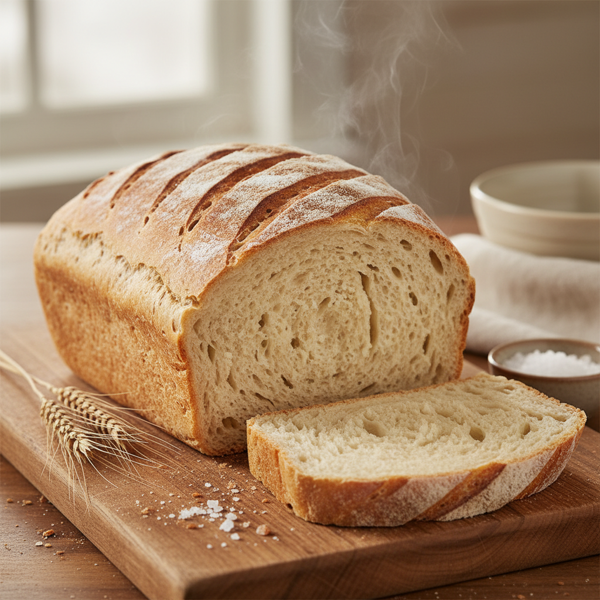
Experience the delightful flavor and texture of this Artisan Poolish White Sandwich Loaf, where a portion of the flour undergoes a pre-fermentation process known as poolish. This method not only enhances the dough's aromatic profile but also contributes to a deeper flavor by allowing natural enzymes to convert the flour's starches into sugars. The recipe yields a soft and beautifully structured loaf, ideal for sandwiches, toast, or simply enjoying with butter. While the overall process spans up to three days, the hands-on preparation time remains straightforward. The intertwining of patience and technique results in a loaf that captures the essence of artisanal baking, inviting you to savor each slice.
18
Servings
72
Calories
8
Ingredients
Ingredients
All-Purpose Flour (unbleached)
1 2/3 cups (Measured (213 g))
Room Temperature Water
7 1/2 ounces (Measured (213 g))
Instant Yeast
1/8 teaspoon (Approximately 3 pinches)
Bread Flour
2 cups (Measured (255 g))
Buttermilk
4 ounces (Measured (111 g))
Butter
1 teaspoon (Melted (6 g))
Salt
1 teaspoon (Rounded tsp table salt (8.5 g))
Instant Yeast
2 teaspoons (Measured (7 g))
Instructions
1
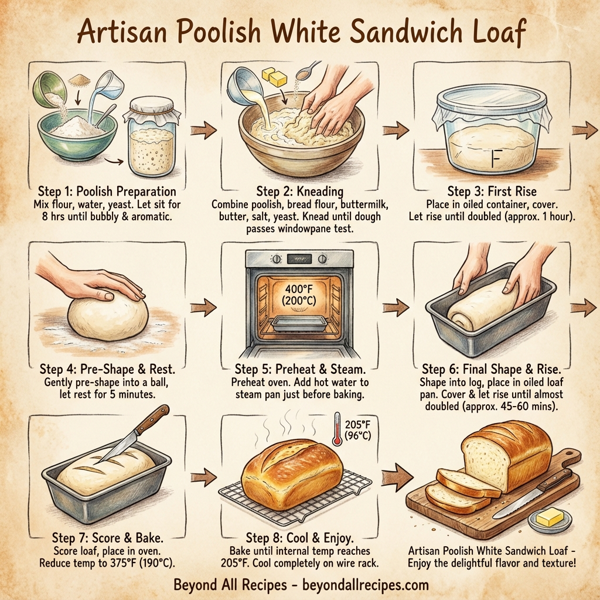
To begin with, prepare the poolish: In a medium bowl, combine 1 2/3 cups of all-purpose flour, 7 1/2 ounces of room temperature water, and 1/8 teaspoon of instant yeast. Mix until well combined, cover the bowl, and let it sit at room temperature for about 8 hours, or until it is bubbly and aromatic.
2
Once the poolish is ready, transfer it to a large mixing bowl. Add 2 cups of bread flour, 4 ounces of buttermilk, 1 teaspoon of butter, 1 teaspoon of salt, and 2 teaspoons of instant yeast to the bowl. Mix the ingredients well until a shaggy dough forms.
3
Knead the dough using your hands or a dough hook attached to a stand mixer. Knead on low speed for about 5 minutes, then allow the dough to rest for 5 minutes. Knead for an additional 5 minutes, continuing until the dough passes the windowpane test—meaning a small piece of the dough can be stretched thin without breaking, allowing light to shine through.
4
Lightly oil a clear container or bowl with straight sides, place the dough inside, and mark its level. Cover the container with plastic wrap and let it rise at room temperature until it doubles in size, which typically takes about 1 hour, depending on the temperature.
5
Once the dough has risen, gently turn it out onto a lightly floured surface and pre-shape it into a ball. Allow it to rest for 5 minutes.
6
While the dough is resting, preheat your oven to 400°F (200°C), placing a pan on the bottom rack for steaming.
7
After resting, gently fold the dough into a ball, tucking in the ends and sealing the edge. Roll the dough back and forth lightly until the edges are sealed, then form it into a log shape with a slightly larger center.
8
Transfer the shaped loaf into an oiled 9" x 5" loaf pan. Cover the dough with oiled plastic wrap and let it rise until it is almost doubled in volume, approximately 45 minutes to 1 hour.
9
Just before baking, carefully add 1 cup of hot water to the steam pan, taking care not to spill on the oven door.
10
Once ready, score the top of the loaf with a sharp knife and place it in the center of the preheated oven. Immediately reduce the oven temperature to 375°F (190°C).
11
After the first 12 minutes of baking, carefully remove the steam pan and rotate the loaf 180 degrees for even baking.
12
Bake for an additional 20 to 30 minutes until the internal temperature of the loaf reaches 205°F (96°C). The crust should be golden brown and have a hollow sound when tapped on the bottom.
13
Once baked, remove the loaf from the pan and let it cool completely on a wire rack before slicing. For longer flavor retention, store the loaf wrapped in a cloth in a cool place.
Nutrition Information
1.3g
Fat
13.9g
Carbs
2g
Protein
0.3g
Fiber
Frequently Asked Questions
Frequently Asked Questions
What is a poolish in bread baking?
A poolish is a pre-fermentation process where a portion of the flour and water are mixed with a small amount of yeast and allowed to sit before making the final dough to enhance flavor and texture.
How long does the poolish need to sit?
The poolish should sit at room temperature for approximately 8 hours until it becomes bubbly and aromatic.
What are the ingredients for the poolish?
The poolish consists of 1 2/3 cups of all-purpose flour, 7 1/2 ounces of room temperature water, and 1/8 teaspoon of instant yeast.
What is the windowpane test?
The windowpane test involves stretching a small piece of dough thin enough to see light through it without it breaking, which indicates proper gluten development.
How long should I knead the dough?
Knead for 5 minutes, let it rest for 5 minutes, and then knead for an additional 5 minutes until it passes the windowpane test.
What type of flour is used in this recipe?
This recipe uses a combination of unbleached all-purpose flour for the poolish and bread flour for the final dough.
What is the purpose of adding buttermilk?
Buttermilk adds moisture, flavor, and contributes to the soft structure of the sandwich loaf.
At what temperature should the oven be preheated?
The oven should be preheated to 400°F (200°C) before the loaf is placed inside.
Why is a steam pan used in the oven?
A steam pan helps create a moist environment which allows the bread to rise fully and develops a better crust.
When should the oven temperature be reduced?
Immediately after placing the loaf in the oven, reduce the temperature from 400°F to 375°F (190°C).
How long does the first rise take?
The first rise typically takes about 1 hour at room temperature or until the dough has doubled in size.
What size loaf pan is recommended?
An oiled 9" x 5" loaf pan is recommended for this recipe.
What should the internal temperature of the bread be when finished?
The bread is fully baked when it reaches an internal temperature of 205°F (96°C).
How many servings does one loaf provide?
The recipe yields approximately 18 servings.
What is the calorie count per serving?
Each serving contains approximately 72 calories.
Why should the loaf be rotated during baking?
Rotating the loaf 180 degrees after the first 12 minutes ensures even baking and browning.
When should the steam pan be removed?
The steam pan should be carefully removed after the first 12 minutes of baking.
How do I know the bread is done if I don't have a thermometer?
The crust should be golden brown and the loaf should produce a hollow sound when tapped on the bottom.
How should the bread be cooled?
Remove the loaf from the pan immediately and let it cool completely on a wire rack before slicing.
How much yeast is used in total?
The recipe uses a total of 2 1/8 teaspoons of instant yeast: 1/8 teaspoon for the poolish and 2 teaspoons for the final dough.
Can I use a stand mixer for this recipe?
Yes, you can use a stand mixer with a dough hook on low speed for the kneading process.
How do I shape the dough into a log?
Fold the dough into a ball, tuck in the ends, seal the edges, and roll it back and forth into a log with a slightly larger center.
What is the weight of the all-purpose flour used?
The 1 2/3 cups of all-purpose flour weighs approximately 213 grams.
What is the weight of the bread flour used?
The 2 cups of bread flour weighs approximately 255 grams.
Should the water for the poolish be hot?
No, the water for the poolish should be at room temperature (approximately 213g).
How should the finished loaf be stored?
For best flavor retention, store the loaf wrapped in a cloth in a cool place.
Why is it important to score the loaf?
Scoring the top with a sharp knife controls where the bread expands during the baking process.
How long is the second rise after shaping?
The second rise takes approximately 45 minutes to 1 hour until the dough is almost doubled in volume.
What is the fat content per serving?
Each serving contains approximately 1.3g of fat.
How much protein is in each slice?
There are 2 grams of protein per serving.