Artisan Elevated Challah
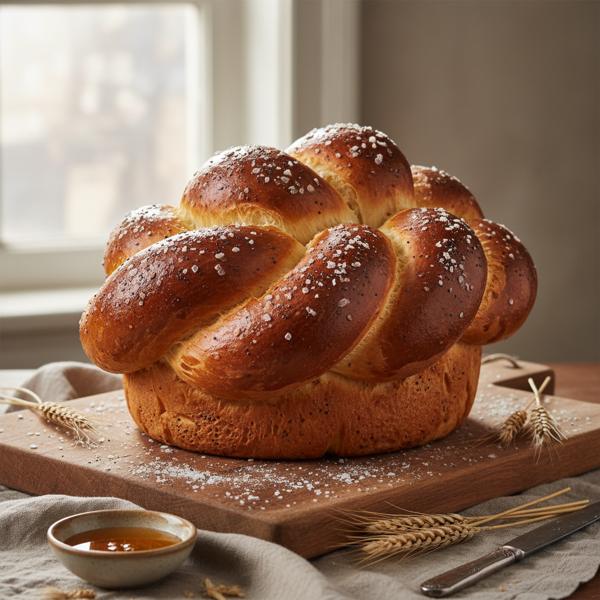
This Artisan Elevated Challah is my favorite take on a traditional Jewish bread, adapted from Marcy Goldman's acclaimed 'Treasury of Jewish Holiday Baking.' Living at high elevation in Colorado means that I’ve had to fine-tune the recipe, but don’t worry, the original ingredients remain just right for most bakers. With its rich, slightly sweet flavor and soft, airy texture, this Challah is perfect for special occasions, everyday meals, or as a delightful base for French toast. Elevate your baking list with quality ingredients and a touch of love, and watch as this bread becomes a weekend ritual for you and your family.
N/A
Servings
200
Calories
8
Ingredients
Ingredients
dry yeast
5 teaspoons (none)
warm water
1 1/2 cups (heated to about 110°F)
sugar
1/2 cup (divided; half for yeast activation)
sugar or honey
1/2 teaspoon (to activate yeast)
vegetable oil
1/3 cup (for dough and greasing)
salt
2 1/2 teaspoons (none)
malt syrup
1/4 teaspoon (optional)
flour
6 cups (bread flour recommended)
Instructions
1
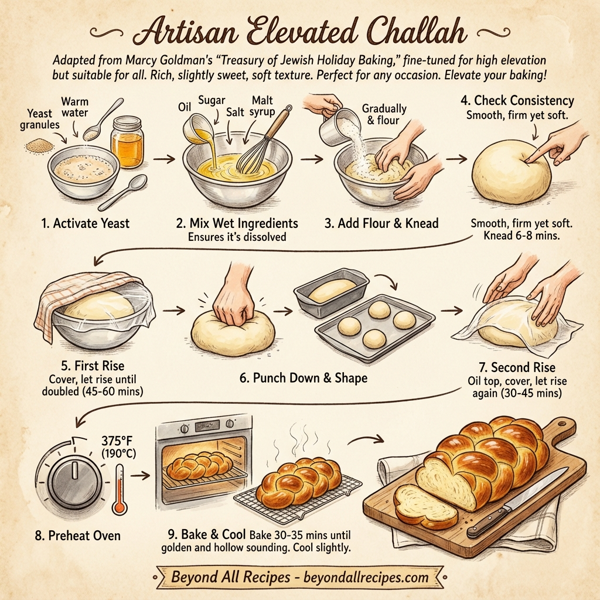
In a small bowl, combine the dry yeast, warm water, and half a teaspoon of sugar or honey. Stir gently and let it stand for about 10 minutes until the mixture is frothy, indicating the yeast is active.
2
In a large mixing bowl, add the vegetable oil, remaining sugar, salt, and malt syrup (if using). Ensure that any sugar is fully dissolved and the honey is melted before moving on.
3
Gradually incorporate the flour, one cup at a time, mixing thoroughly between each addition. As the dough thickens, use your hands for mixing; getting hands-on will not only be fun but give you a good feel for the dough's consistency.
4
The dough should feel smooth and velvety. Knead the dough for 6-8 minutes, ensuring it becomes firm yet soft. When poked, the dough should slowly regain its shape while still showing a slight dent.
5
Shape the kneaded dough into a ball and place it in a well-greased bowl. Cover it with a plastic bag and a towel to maintain warmth. Allow it to rise until doubled, roughly 45 minutes for low elevation, and about an hour for high elevation.
6
After the first rise, punch down the dough to release air. Shape it into three equal balls and place them in a greased 12x5 inch pan or side by side on a baking sheet as per your preference.
7
For best results, oil your hands and lightly coat the top of the dough at this stage. Cover the bowl or baking sheet again as before, and let the dough rise until doubled again, about 45 minutes at higher elevations and closer to 30 minutes at lower elevations.
8
During the last rise, preheat your oven to 375°F (190°C).
9
Once the dough has risen for the second time, remove it from the covering and bake it in the preheated oven for 30-35 minutes, or until golden brown and hollow sounding when tapped on the bottom. Allow it to cool slightly before serving.
Nutrition Information
5g
Fat
35g
Carbs
5g
Protein
Frequently Asked Questions
Frequently Asked Questions
What is Artisan Elevated Challah?
It is a rich, slightly sweet traditional Jewish bread with a soft, airy texture, adapted from Marcy Goldman's 'Treasury of Jewish Holiday Baking' and fine-tuned for high elevation.
Who is the original author that inspired this recipe?
The recipe is adapted from Marcy Goldman's acclaimed book, 'Treasury of Jewish Holiday Baking.'
Is this Challah recipe suitable for high altitudes?
Yes, this recipe has been specifically fine-tuned for high elevation in Colorado, though the original ingredients remain suitable for most bakers at any altitude.
What are the best uses for Artisan Elevated Challah?
It is ideal for special occasions, everyday meals, or as a high-quality base for French toast.
How much dry yeast is required for this recipe?
The recipe requires 5 teaspoons of dry yeast.
What temperature should the water be for yeast activation?
The warm water should be heated to approximately 110°F.
How long should the yeast stand to become frothy?
You should let the yeast mixture stand for about 10 minutes until it becomes frothy, which indicates it is active.
How much sugar is needed in total?
The recipe calls for 1/2 cup of sugar, which is divided: half for the dough and half for yeast activation.
Can I use honey instead of sugar to activate the yeast?
Yes, you can use 1/2 teaspoon of either sugar or honey to activate the yeast.
What type of oil is recommended?
The recipe uses 1/3 cup of vegetable oil for both the dough and for greasing the bowl.
How much salt is included in the dough?
The dough requires 2 1/2 teaspoons of salt.
Is there an optional ingredient for flavor?
Yes, you can optionally include 1/4 teaspoon of malt syrup.
What kind of flour should I use for Challah?
The recipe recommends using 6 cups of bread flour.
How should I add the flour to the mixture?
Incorporate the flour gradually, one cup at a time, mixing thoroughly between each addition.
How long do I need to knead the dough?
Knead the dough for 6-8 minutes until it becomes firm yet soft and velvety.
How do I test if the dough is properly kneaded?
When poked, the dough should slowly regain its shape while still showing a slight dent.
What is the best way to let the dough rise?
Place the dough ball in a well-greased bowl, cover it with a plastic bag and a towel, and keep it in a warm place.
How long does the first rise take at high elevation?
At high elevation, the first rise takes about one hour.
How long does the first rise take at low elevation?
At low elevation, the first rise takes approximately 45 minutes.
What should I do after the first rise?
Punch down the dough to release the air and then shape it into three equal balls.
What pan size is suggested for this recipe?
You can use a greased 12x5 inch pan or place the dough side by side on a baking sheet.
Should I apply oil to the dough before the second rise?
Yes, oiling your hands and lightly coating the top of the dough before the second rise is recommended for best results.
How long is the second rise for this Challah?
It takes about 45 minutes at higher elevations and closer to 30 minutes at lower elevations.
What temperature should the oven be?
The oven should be preheated to 375°F (190°C).
How long does the Challah bake for?
Bake the dough for 30-35 minutes or until golden brown.
How can I tell if the bread is done baking?
The bread is done when it is golden brown and sounds hollow when you tap on the bottom.
How many calories are in one serving?
There are approximately 200 calories per serving.
What is the nutritional breakdown of this bread?
Each serving has 5g of fat, 35g of carbohydrates, and 5g of protein.
How many ingredients are in this recipe?
There are 8 primary ingredients used in this recipe.
Do I need to melt the honey before mixing?
Yes, ensure any sugar is fully dissolved and the honey is melted before incorporating the flour.